Binary Options for Beginners: A Practical Starting Guide
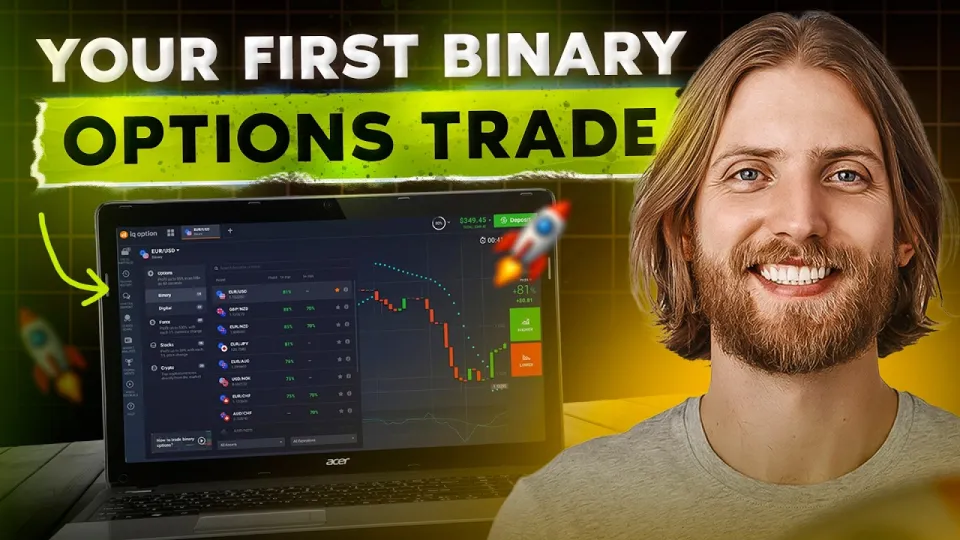
· based on the channel Binary options tutorial for beginners
Key takeaways
- Binary options are all-or-nothing contracts: you either receive a fixed payout or lose the entire stake for that trade.
- Typical payouts on platforms such as Quotex, Pocket Option and Binarium sit around 70-95%, while a losing trade costs 100% of the stake.
- A 60% win rate at an 80% payout still leaves the trader with roughly break-even results, so payout size matters as much as accuracy.
- Most platforms offer demo accounts with virtual funds, which is the standard first step before depositing real money.
- Trade sizes of 1-5% of the account balance per position keep a normal losing streak from wiping out the deposit.
Binary options are short-term contracts where you predict whether an asset's price will be above or below the current level at a set expiry time; if you are right you receive a fixed payout, and if you are wrong you lose the stake. A beginner should start with a demo account on a regulated platform, learn one or two assets, keep each trade at 1-5% of the balance, and only move to real money after a consistent result over at least 100 trades. A common entry point is a Quotex account opened through this registration link, which also serves as the platform used in most beginner walkthroughs.
How binary options actually work
A binary option is a contract with two possible outcomes and a fixed expiry, which is why it is called binary. You choose an asset (currency pair, stock, index, commodity or crypto), a direction (higher or lower than the current price), a stake and an expiry ranging from about 30 seconds to several hours or days.
When the contract expires, one of two things happens: the platform credits the payout percentage (typically 70-95% of the stake) to your balance, or it takes the entire stake. There is no partial loss and no position you can hold past expiry, which is the core difference from spot forex or CFD trading.
Three numbers decide whether the strategy survives:
- Payout percentage - the profit on a winning trade.
- Win rate - the share of trades that finish in the money.
- Stake size - how much of the balance goes into each position.
At an 80% payout you need a win rate above 55.6% just to break even, because a win earns 0.8 of the stake while a loss costs 1.0. At a 70% payout the break-even win rate rises to about 58.8%. That math is the reason payout size matters as much as accuracy.
First steps for a binary options beginner
The fastest way to start is to register on a platform, open a demo account and place a few dozen trades with virtual money before any deposit. Quotex, Pocket Option and Binarium all offer demo modes, and the mechanics are identical to live trading apart from the funds.
A workable sequence for the first month:
- Register and complete identity verification, since withdrawals usually require it.
- Fund the demo account with the virtual equivalent of the amount you could realistically deposit.
- Pick one asset, usually a liquid pair such as EUR/USD, and one expiry length, for example 5 minutes.
- Log every trade: time, direction, reason, result. Fifty to a hundred entries show whether there is an edge or just luck.
- Only after a stable result, deposit real money and reduce stake size to 1-5% of the balance.
Choosing a binary options platform
The platform matters less than the payout terms, withdrawal conditions and the asset list you actually trade. The three most often recommended to beginners are Quotex, Pocket Option and Binarium, and each has a different profile.
- Quotex is known for a simple interface, a low minimum deposit and a wide set of expiries, which suits people learning the mechanics.
- Pocket Option offers a social trading feed where you can see other traders' positions, plus a broad asset list including crypto.
- Binarium focuses on a straightforward classic layout with fixed-time contracts and a range of account tiers.
Whatever the choice, check three things before depositing: whether the entity behind the site is licensed in your jurisdiction, how long withdrawals take and what fees apply, and whether the payout on your chosen asset is above roughly 80%. Binary options are banned or restricted for retail clients in several countries, including the EU and the UK, so confirm the legal status where you live.
A simple beginner strategy framework
No strategy guarantees a win, but a structured approach prevents the most common losses. The goal of the first phase is not a big profit but a repeatable process with controlled risk.
One asset, one expiry. Switching between ten instruments and five expiry lengths makes results impossible to evaluate. Pick EUR/USD on a 5-minute expiry and stay there for the first hundred trades.
Trend filter. Trade in the direction of the higher timeframe: if the 1-hour chart is above its 50-period moving average, look mainly for higher contracts. Counter-trend entries are where beginners lose most often.
Support and resistance. Mark the levels where price reversed at least twice in the past sessions. A rejection candle at such a level, confirmed by a momentum indicator such as RSI leaving overbought or oversold territory, is a common entry trigger.
Money management. Risk 1-5% per trade. With 2% stakes, ten consecutive losses cost about 18% of the balance; with 20% stakes the same streak destroys 89%. Losing streaks of five to eight trades are normal even with a real edge.
Stop rules. Set a daily loss limit (for example 10% of the balance) and a daily profit target, and close the terminal when either is hit.
Common beginner questions and mistakes
Most doubts from new traders repeat the same themes: whether a demo account is worth the time, why a trade lost despite a correct-looking chart, and whether martingale-style stake doubling works.
The demo account is worth it, but only if it is treated as real: same stake size, same rules, same journal. A demo where every trade is a maximum-size gamble teaches nothing.
A trade can lose on a correct chart read because the expiry is too short for the move to develop, or because the payout is low enough that even a decent win rate stays unprofitable. Expiry length and payout are part of the strategy, not details.
Martingale - doubling the stake after each loss - is the most common account killer in binary options. With a fixed payout, recovering a streak of six or seven losses requires stakes many times the original, and one final loss erases the balance. Fixed fractional stakes are slower but survive.
Finally, treat any signal seller, VIP group or "guaranteed robot" as a red flag. The only verifiable data is your own trade journal.
All links from the breakdown
- Quotex registration: https://dakaklik.com/_quotex?creative_id=WzzpYsjS3ps
- Pocket Option registration: https://dakaklik.com/_PocketOption?creative_id=WzzpYsjS3ps
- Binarium registration: https://dakaklik.com/_Binarium?creative_id=WzzpYsjS3ps
- NordVPN: https://dakatop.link/Nord_us?creative_id=WzzpYsjS3ps
Summary
Binary options reward discipline rather than prediction: fixed payouts mean the payout percentage and the stake size decide the result as much as the win rate does. Start on a demo account, master one asset and one expiry, risk no more than 1-5% per trade, and keep a written journal of every position. Check the license and withdrawal terms of any platform before depositing, and remember that retail binary options are restricted in several jurisdictions. The video breakdown on this topic comes from the channel Binary options tutorial for beginners, which walks through the same starting sequence. To begin with the platform used in that walkthrough, open a Quotex account here and start on demo mode.
Questions & answers
How much money do I need to start trading binary options?
Many platforms accept deposits from around $10, and Quotex is often cited for a low minimum. A practical approach is to deposit only an amount you can afford to lose entirely and keep each trade at 1-5% of it, so a $100 balance means $1-5 per position.
Is a demo account useful or a waste of time?
It is useful if you treat it exactly like live trading: same asset, same expiry, same stake size relative to the virtual balance, and a written journal. A demo used for maximum-size gambling builds no skill, because the psychology of risking real money is missing.
Why do my trades lose even when the chart analysis looks right?
The most common causes are an expiry too short for the move to develop, entering against the higher-timeframe trend, and a payout low enough that a decent win rate still loses money. At a 70% payout you need more than about 58.8% wins just to break even.
Does doubling the stake after a loss (martingale) work in binary options?
It works until it does not: a streak of six or seven losses requires stakes many times the original, and with fixed payouts one final loss can erase the account. Fixed fractional stakes of 1-5% grow more slowly but survive normal losing streaks.
Source: Binary Options | Binary Options Tutorial for Beginners | Where Should You Start? · Markdown version